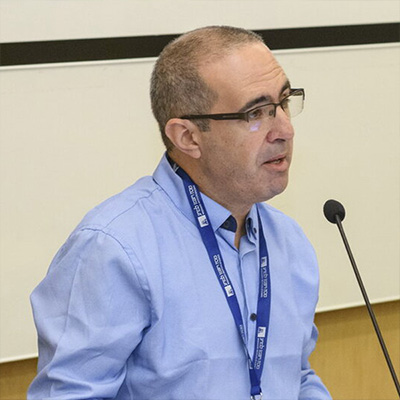
Peleg Hasson, Ph.D.
Peleg Hasson, Ph.D., the IIT Director of the Michigan-Israel Partnership, is an associate professor in the Department of Genetics and Developmental Biology and head of the Tissue Development and Regeneration laboratory at the Ruth and Bruce Rappaport Faculty of Medicine at Technion-Israel Institute of Technology, where he has been since 2010. Dr. Hasson received his Bachelor of Science, Master of Science and Ph.D. from the Hebrew University of Jerusalem. He continued his postdoctoral studies at the National Institute for Medical Research in London, which is part of the United Kingdom’s Medical Research Council.
His work focuses on the crosstalk and interactions that take place between the extracellular matrix (ECM) and the distinct cell types within the skeletal muscle and the cardiovascular system, two tissues that are rich in ECM, and that many human diseases that affect them are ECM-related. His work concentrates on embryonic development and adult homeostasis. Specifically, much of his focus is on the roles played by members of the lysyl oxidase (LOX) family, a family of enzymes that regulate ECM maturation in otherwise normal scenarios but also in multiple pathologies. It is now clear that members of this family not only participate in ECM maturation, as once thought, but rather are implicated in a plethora of other unrelated processes. Using conditional knockout strategies in mice, his lab has recently shown that the founding member of the family (Lox) regulates muscle composition during embryonic development and muscle regeneration. The lab further demonstrated that another member of the family, LoxL3, is required for the initiation of myotendinous junctions, via regulation of fibronectin. The interest in Lysyl oxidases and the associated ECM remodeling effects they carry out has prompted his interest in fibrosis (scarring), a pathological condition where excessive ECM deposition takes place and which is associated with ~30% of the deaths in the western world. By employing lessons learned from ECM remodeling during embryonic development, much of the effort in the Hasson lab now focuses on developing strategies to attenuate the fibrotic reaction in various diseases and tissues.